 blog
blog
Where to Buy Prayer Mats: A 2026 Buying Guide
Table of Contents
- Where to Buy Prayer Mats: Online vs. In-Store Options
- Types of Prayer Mats: From Janamaz to Travel-Size
- How to Choose a Prayer Rug: A Step-by-Step Guide
- Cushioned Prayer Rugs for Comfort and Support
- Materials and Fabric Quality: What Makes a Mat Last
- Prayer Mat Care and Maintenance
- Gift-Ready Prayer Mats for Islamic Occasions
- Frequently Asked Questions
Last Updated: September 11, 2026
Where to Buy Prayer Mats: Online vs. In-Store Options
A prayer mat is a clean, dedicated surface used for salah, and where you buy prayer mats matters as much as what you buy. Online sellers offer the widest selection of sizes, fabrics, and motifs, often at lower prices, but you cannot feel the pile or check the backing before it ships. A physical store lets you unroll the mat, kneel on it, and judge the weave in person, though the selection is limited to what is on the shelf that day.
For most people, the practical answer is a hybrid: browse online for range and price, then buy from a seller whose return policy protects you if the mat disappoints. Rumi Bookstore & Gifts has served the Muslim community from its Fremont showroom since 1999, and worldwide through its website. Customers can shop either way with the same seller.
What to Look for in a Reputable Seller
A reputable seller states the fiber content, dimensions, and country of origin on every listing, and accepts returns on unused mats. Look for clear photographs of the actual product rather than stock images, a written care guide, and a real address or phone number. Sellers who describe a mat only as "Islamic design" without naming the material are usually hiding a thin, synthetic build.
Types of Prayer Mats: From Janamaz to Travel-Size
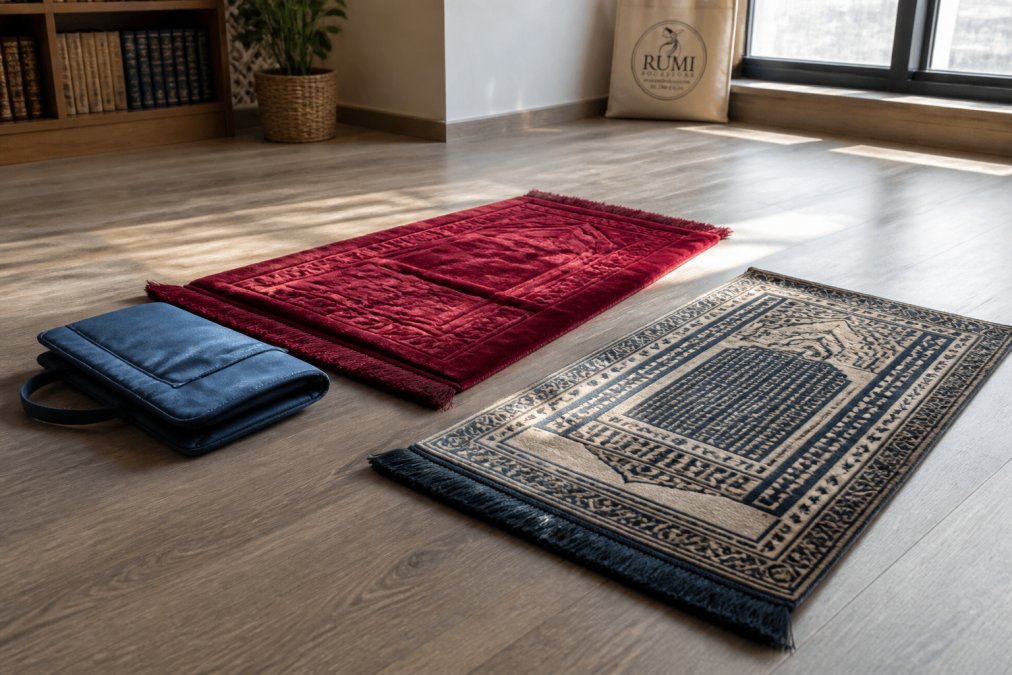
The main types of prayer mats are traditional woven rugs, plush velvet janamaz, padded comfort mats, and thin foldable travel mats. Most households end up owning two: a substantial mat for daily worship at home and a lightweight one for the car, office, or travel.
Traditional Woven and Velvet Styles
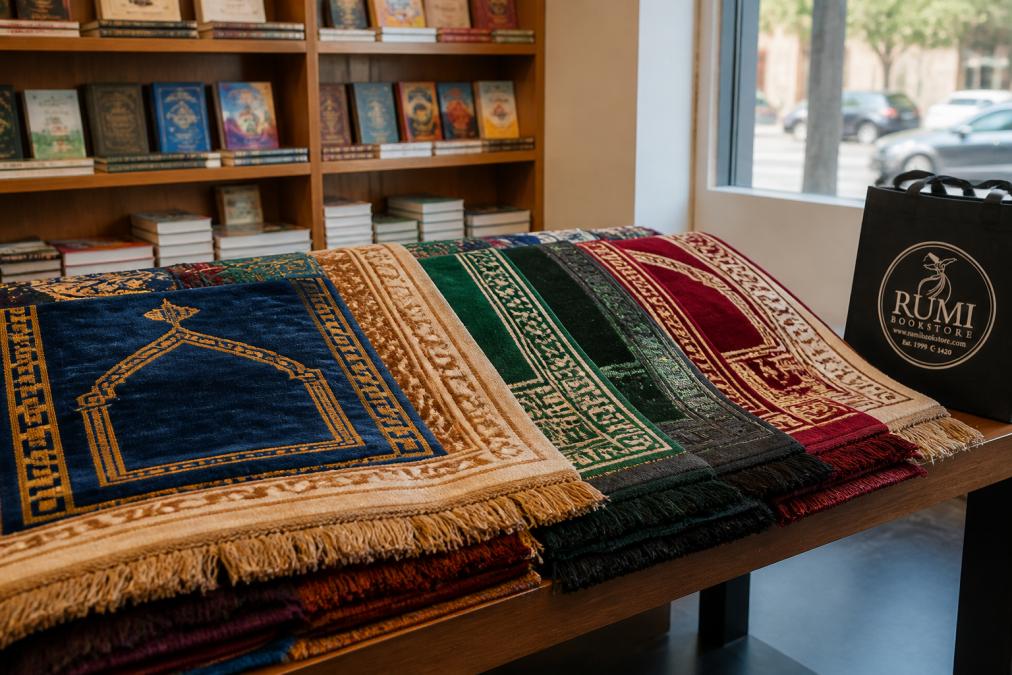
Woven mats, often Turkish-made or machine-loomed in cotton and chenille, hold up to daily use and clean easily. Velvet janamaz offer a silk-touch surface with intricate patterns and a cushioned layer under the knees. Both suit a permanent spot in the home and double as decor.
Portable and Foldable Mats
Travel-size mats compress into a pouch roughly the size of a hardcover book. They are thinner by necessity, so look for a non-slip backing and a foam core of at least a few millimeters on hard floors. Many include a built-in compass to confirm the qibla direction in unfamiliar buildings.
| Mat Type | Best For | Key Trade-Off |
|---|---|---|
| Woven cotton or chenille | Daily home use | Durable, but less padding |
| Velvet janamaz | Comfort and decor | Plush feel, needs gentle washing |
| Padded comfort mat | Knees and joints | Bulkier to store |
| Foldable travel mat | Commutes and trips | Thin, limited cushioning |
How to Choose a Prayer Rug: A Step-by-Step Guide
Choosing a prayer rug comes down to five decisions: size, floor surface, padding and joint support, material, and portability. Work through them in order and the choice narrows quickly.
- Measure your prayer space and your body. A standard mat runs roughly 110 by 70 centimeters (about 43 by 27 inches), which suits an average adult in sujud. Taller worshippers and anyone with a wide stance should look for a longer mat, often 120 centimeters or more, so the forehead and hands stay on the mat. In a tight corner, measure the floor first, a mat that overlaps furniture gets stepped on and soiled.
- Match the backing to the floor. On carpet, a thin woven mat grips on its own. On tile, hardwood, or concrete, a mat without a non-slip backing slides during sujud, a distraction and a fall risk for older worshippers. Look for a rubberized or textured grip backing, not a smooth cotton underside.
- Set your joint-support threshold before you shop for looks. Prolonged kneeling and prostration put repeated pressure on the knees, ankles, and tops of the feet, and worshippers who pray five times a day on a hard floor often feel it in the knees and lower back first (PubMed). If you have knee or hip discomfort, or you are buying for an older relative, prioritize a medium-density foam core of roughly one to two centimeters over pattern and pile. Too soft lets the knees sink unevenly; too thin offers no relief. The target is firm enough to stay stable, thick enough to cushion the kneecap and instep.
- Match the material to how you will clean it. Cotton and chenille tolerate regular washing and resist pilling. Velvet and silk-touch mats keep their sheen only with gentle handling. Polyester blends are inexpensive and colorfast but flatten where knees and foreheads press most. For daily use by multiple people, a washable woven mat usually outlasts a delicate plush one.
- Decide on portability last. If the mat will travel to the office, the car, or a mosque, weight and folded size matter more than pile depth. A travel mat that compresses to book size is worth more in a bag than a plush mat left at home.
A Note on Sizing for Shared and Multi-Person Use
Households that pray together sometimes buy a single wide mat rather than several singles. A multi-person prayer rug seats two or more worshippers side by side, but it is heavier, harder to wash, and harder to store rolled. For daily individual use, a standard single mat is easier to keep clean; for guests during Ramadan and Eid, a wide mat saves floor space and setup time. Measure the room and count how many people actually pray at once before choosing.
Why Sourcing and Material Origin Belong in This Decision
A growing number of buyers ask where the cotton or wool came from and whether the dyes are low-impact. Sellers who can answer usually hold higher manufacturing standards across the board, because tracing a fiber supply chain takes more care than buying whatever bulk fabric is cheapest. If organic or low-impact fibers matter to you, ask the seller directly, a vague answer is itself information. Rumi Bookstore has been serving the Muslims of the Bay Area through our showroom in Fremont, California since 1999, and worldwide through our website for 27 years. modest faith apparel.
Cushioned Prayer Rugs for Comfort and Support
Cushioned prayer rugs add a foam or high-density fill layer between you and the floor, which matters for anyone praying five times a day on a hard surface. The cushioning also provides orthopedic support for older worshippers and those recovering from knee or back strain.
Thicker is not automatically better. A mat that is too soft lets your knees sink unevenly, which can feel less stable during sujud. A medium-density pad of roughly one to two centimeters gives support without wobble (PubMed). Look for a removable or washable cover, because cushioned mats absorb more moisture and need cleaning more often than flat weaves.
Materials and Fabric Quality: What Makes a Mat Last
Fabric quality determines how a mat ages, and the difference shows up within a year. Cotton and chenille resist pilling and tolerate regular washing. Velvet keeps its sheen only with gentle handling. Polyester blends are inexpensive and colorfast but flatten where knees and foreheads press most.
Textile quality comes down to three things: fiber content, weave density, and backing. A dense weave holds its shape and resists fraying at the edges. A proper non-slip backing keeps the mat from sliding on tile, both a safety issue and a distraction during prayer. Check the border seams, where cheap mats fail first.
Do not machine-wash a velvet or silk-touch mat on a normal cycle. The pile crushes and the border stitching pulls apart, and the mat is effectively ruined after one wash.
Prayer Mat Care and Maintenance
Most prayer mats last years with simple care, but the details differ by material. The goal is to remove soil and moisture without crushing the pile, stretching the weave, or breaking down the backing.
Daily and Weekly Care
Shake the mat out after use to dislodge dust and grit, which otherwise works into the weave and abrades the fibers. Spot-clean spills immediately with a damp cloth and mild detergent, the longer a stain sits, the more it sets. Woven cotton and chenille mats tolerate a gentle cold cycle; use a mesh bag for small mats and skip the dryer. Air-dry flat rather than hanging, because hanging a wet mat pulls the weave out of square. Velvet, silk-touch, and embroidered mats should never go in a washing machine, vacuum on the lowest setting with a brush attachment, or brush by hand along the pile (cleaninginstitute.org).
Matching the Method to the Material
- Cotton and chenille: machine-washable on gentle, cold; air-dry flat; tolerates frequent cleaning.
- Velvet and silk-touch: spot-clean only; vacuum low or brush by hand; keep away from heat, which dulls the sheen.
- Polyester blends: easy to wash but prone to flattening; rotate the mat periodically so wear spreads evenly instead of concentrating where knees and foreheads press.
- Padded and foam-core mats: many have a removable, washable cover, wash the cover, wipe the foam core, and never submerge the core, which traps moisture and can grow mildew.
- Wool: spot-clean and air out; wool resists odor naturally but felts if agitated in hot water.
Storage That Preserves the Pile
Store mats rolled rather than folded if you have the space. Folds create permanent creases in the pile, and those creases are the first places a mat looks worn, the fibers stay bent and never fully recover. Roll the mat pile-side out so the surface that touches your face is on the outside. Keep stored mats away from direct sun, since prolonged light fades even colorfast dyes, and store them dry, a mat put away damp is the most common cause of mildew and musty odor.
When to Repair vs. Replace
Check the border seams, where inexpensive mats fail first. A loose border stitch can often be re-sewn by hand before it unravels further, extending the mat's life by years. A mat with a flattened, matted pile in the center, a cracked or crumbling non-slip backing, or mildew that returns after cleaning is usually past saving, the backing no longer grips and the mat becomes a slip risk on hard floors.
Do not machine-wash a velvet or silk-touch mat on a normal cycle, and do not put any padded mat's foam core in water. The pile crushes, the border stitching pulls apart, and the core traps moisture, the mat is effectively ruined after one wash.
If you rotate between two mats, one in use, one airing out, each mat gets a full day to dry and recover its pile, and both last noticeably longer than a single mat used every day.
Gift-Ready Prayer Mats for Islamic Occasions
A prayer mat is one of the most useful gifts for Ramadan, Eid, a wedding, or a new home, because it is used daily rather than displayed once. Gift-ready mats usually come boxed or tied with a ribbon, and the most thoughtful options pair a mat with a matching pouch or prayer beads.
For a child or a new Muslim, a smaller mat in a bright pattern makes the gift personal. For an older relative, a cushioned mat with orthopedic support shows more care than an ornate one. If you are unsure of the recipient's taste, choose a neutral palette with traditional motifs, which suits almost any home.
Finding a prayer mat that fits your floor, your knees, and your budget takes a little research, and the seller you choose matters as much as the mat itself. Rumi Bookstore & Gifts has supplied the Muslim community with prayer rugs, Islamic literature, and gift items from its Fremont showroom since 1999, and our online store now ships those same products worldwide. Browse our prayer mat collection for traditional woven styles, plush velvet janamaz, cushioned comfort mats, and foldable travel mats, along with gift-ready sets for Ramadan and Eid. Shop now with Rumi Bookstore & Gifts.
Frequently Asked Questions
Where can I find good quality prayer mats?
Look for sellers who specialize in Islamic goods and can tell you about the materials and construction. A dedicated store like Rumi Bookstore & Gifts, which has served the Muslim community since 1999, typically offers better quality than general marketplaces. Check for details on fabric type, backing, and whether the mat is machine washable. Reading customer reviews and asking about return policies also helps you avoid flimsy mats that wear out quickly.
What is the difference between a prayer mat and a prayer rug?
The terms are often used interchangeably, but a prayer mat (or janamaz) is typically thinner and more portable, while a prayer rug is usually thicker, larger, and may be made of woven wool or velvet. Prayer rugs often feature more intricate patterns and a cushioned layer for comfort. For daily use at home, a rug offers more durability; for travel, a mat is easier to fold and carry.
How do I choose the right thickness for a prayer mat?
Thickness affects comfort and portability. A thin mat (about 2-3 mm) is lightweight and easy to fold for travel or office use. A thicker cushioned prayer rug (5-10 mm) provides orthopedic support for knees and joints, which helps during longer prayers or if you have joint sensitivity. If you pray on hard floors, a cushioned option is worth considering. For travel, stick with a thinner, foldable design.
How should I care for and clean my prayer mat?
Check the care label first. Most velvet or chenille mats can be vacuumed gently and spot-cleaned with mild soap and water. Washable mats can go in the machine on a gentle cycle, but air-dry them to prevent damage to the non-slip backing. Avoid harsh chemicals and direct sunlight, which can fade intricate patterns. For daily use, shake out dust and rotate the mat occasionally to even out wear.